Boca Raton expects to lose $8.14 million a year in property tax revenue under Amendment 3, then $16.73 million. A state lawmaker told the City Council not to worry.
Overview
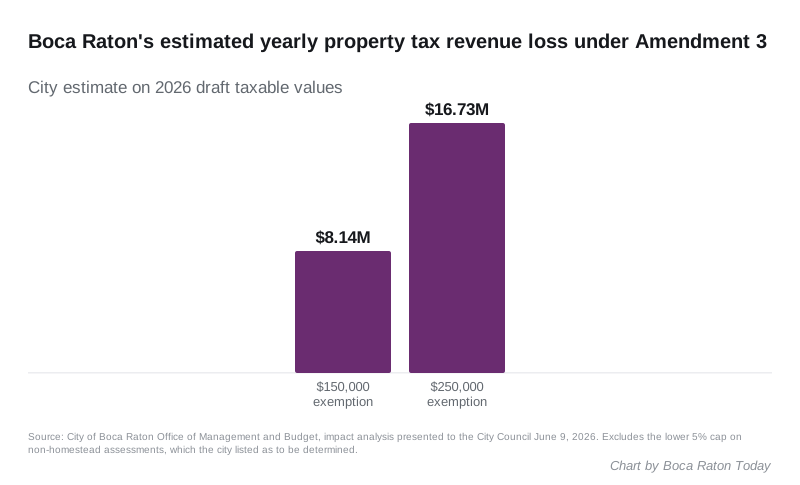
Amendment 3 passed statewide Nov. 3. Boca Raton estimates it will lose about $8.14 million a year in property tax revenue once the homestead exemption rises to $150,000, and about $16.73 million a year at $250,000. Homeowners with a homestead exemption pay less in city and county taxes. School taxes do not change.
Boca Raton’s city government expects to lose up to $16.73 million a year in property tax revenue now that Florida voters have approved Amendment 3. That is the city’s own estimate, from an impact analysis its budget office presented to the City Council.
On Tuesday, a state lawmaker told the council not to worry.
State Rep. Peggy Gossett-Seidman, whose district includes Boca Raton, spoke at the start of Tuesday’s council meeting, according to the city’s video of the meeting. “The concerns of Boca Raton for Amendment 3, I will say to you, do not worry,” she said.
She said she had spoken to Gov. Ron DeSantis, the governor-elect and House leadership. “They have committed to having some kind of a fund for municipalities and counties who may be in some kind of dire situation from Amendment 3,” she said. She did not give an amount or a timeline.
What Amendment 3 changes
Amendment 3 passed with 61.98% of the vote, above the 60% a constitutional amendment needs. The figure is from the state Division of Elections’ unofficial returns; 4,922,400 voters said yes and 3,019,415 said no.
The ballot summary says the amendment:
- raises the homestead exemption for all non-school taxes to $150,000 in 2027 and $250,000 in 2028, then adjusts it for inflation
- gives people who are not Florida residents on Dec. 31, 2026, the existing exemption until their fifth year of exemption
- cuts the yearly cap on assessment increases for non-homestead property from 10% to 5%
- limits what cities and counties may spend property taxes on, to public safety, schools, infrastructure, natural resources, bond debt, employee retirement, and operations and administration
- takes effect Jan. 1, 2027
Today a Boca Raton homestead gets $50,000 off its taxable value for non-school taxes, made up of two $25,000 exemptions, according to the city’s analysis.
What the city expects to lose
The city’s Office of Management and Budget made the impact analysis for a June 9 council workshop. Jim Zervis, then the deputy city manager and chief financial officer, presented it. He is now the interim city manager. The city posted a summary on its website.
The analysis found:
- a $150,000 exemption cuts city revenue by about $8.14 million a year
- a $250,000 exemption cuts it by about $16.73 million a year
- $16.73 million is 11.56% of the city’s property tax revenue and 6.10% of its general fund revenue
- the city’s taxable value would fall 11.01%, from about $41.6 billion to about $37.1 billion
The analysis did not put a figure on the effect of the lower 5% cap on non-homestead property.
The city said the current budget is not affected. The loss would begin with the fiscal 2027-28 budget, which starts Oct. 1, 2027, and be phased in over two fiscal years.
Property taxes paid for $144.7 million of the city’s $274.2 million draft general fund budget for fiscal 2026-27, the analysis said. That is 52.77%.
Staff told the council it may face choices on “service levels, budget priorities, millage rates, fees, or other revenue options,” the city’s summary said.
Who pays more of the bill
Homestead property makes up about 40% of the city’s taxable value. Under Amendment 3, the city estimates that share falls to about 33%. The rest of the tax base shifts to non-homestead property, which the analysis lists as commercial, industrial, seasonal residents and rentals.
The amendment does not touch non-ad valorem assessments. Those are the flat charges on a tax bill for things like fire rescue, stormwater and solid waste, the analysis said.
What it means for you
- If you have a homestead exemption: your city and county taxes fall. The city’s analysis modeled two Boca Raton homes worth about $1.1 million and $1.2 million, one homesteaded in 1992 and one in 2023. With a $250,000 exemption, each saved $2,137 a year in non-school taxes, based on 2025 tax data. That was 42.3% of the older owner’s bill and 16.3% of the newer owner’s.
- If you moved to Florida recently: you get the larger exemption only from your fifth year of exemption, if you were not a Florida resident on Dec. 31, 2026.
- If you own a rental, a second home or a business property: you get no new exemption. Your assessment can rise no more than 5% a year instead of 10%.
- Your school taxes: unchanged. The exemption covers only non-school taxes.
- This year’s bill: unchanged. The 2026 bills mailed this month use the current exemptions, and the property taxes page has due dates and discounts.
The amendment also changes the city’s estimate for the proposed police headquarters bond on the March 9 ballot. With Amendment 3 in place, the city puts the bond’s tax rate at about 0.2113 mills, up from 0.1904 mills.
What happens next
Gossett-Seidman said the Legislature has eight committee weeks ahead, and its regular session begins the first week of March. She asked the city to send its funding requests early.
A council member asked how special districts funded entirely by property taxes, such as mosquito control and fire districts, would cope. “We’ll have a plan for the special districts,” she said. “We have committed to not allowing anyone to fail.”
Another council member asked about a proposed Florida taxpayer bill of rights, which the council member said DeSantis wants a special session to consider. “It’s just talk at this point,” Gossett-Seidman said.
The city’s estimates were made on 2026 draft taxable values. They will change as new values come in for the 2027 tax year.
Have your say